Muhammad Jalil Rahimi
“What is your favorite artwork?”
Curatorial Rationale
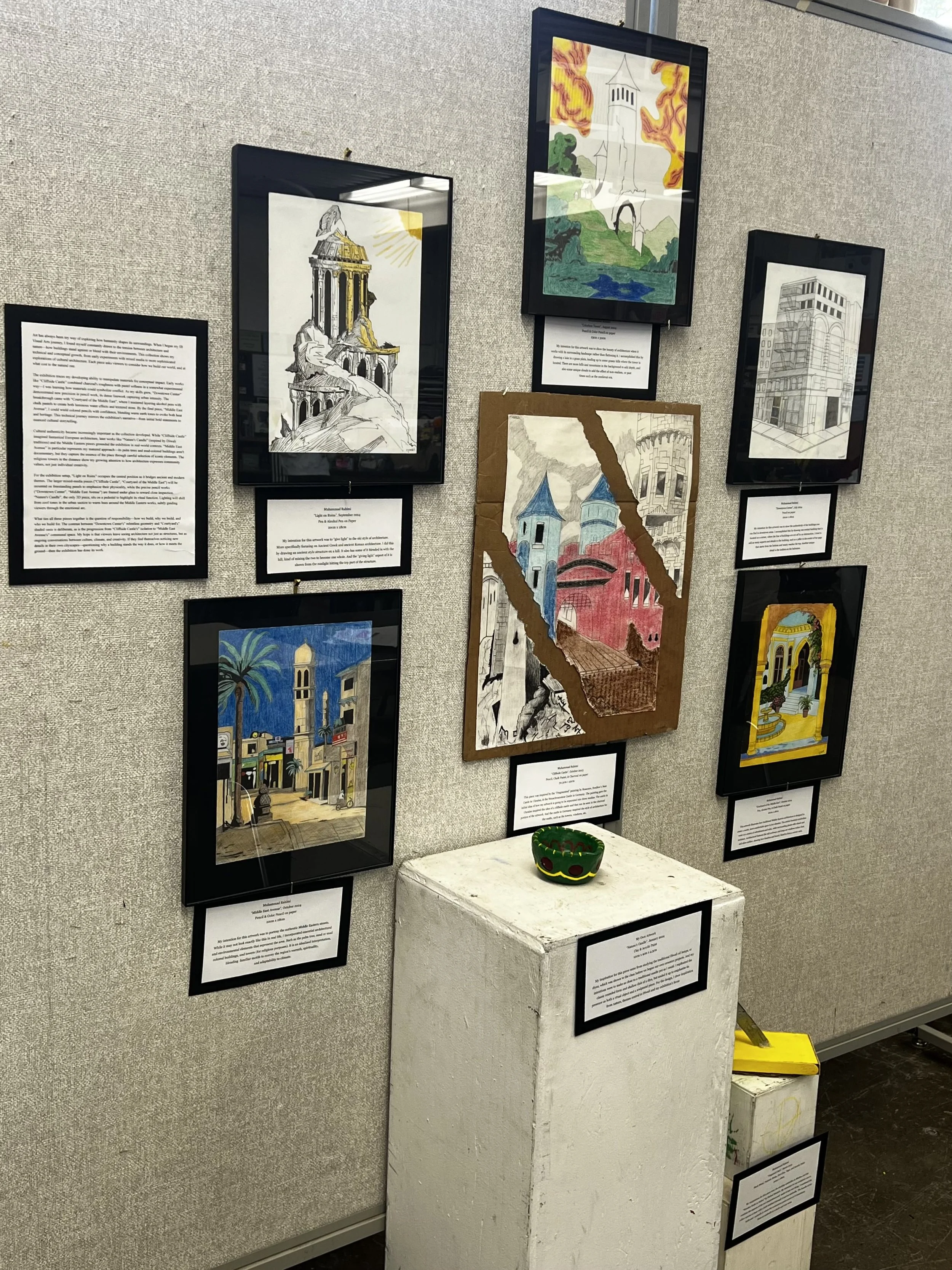
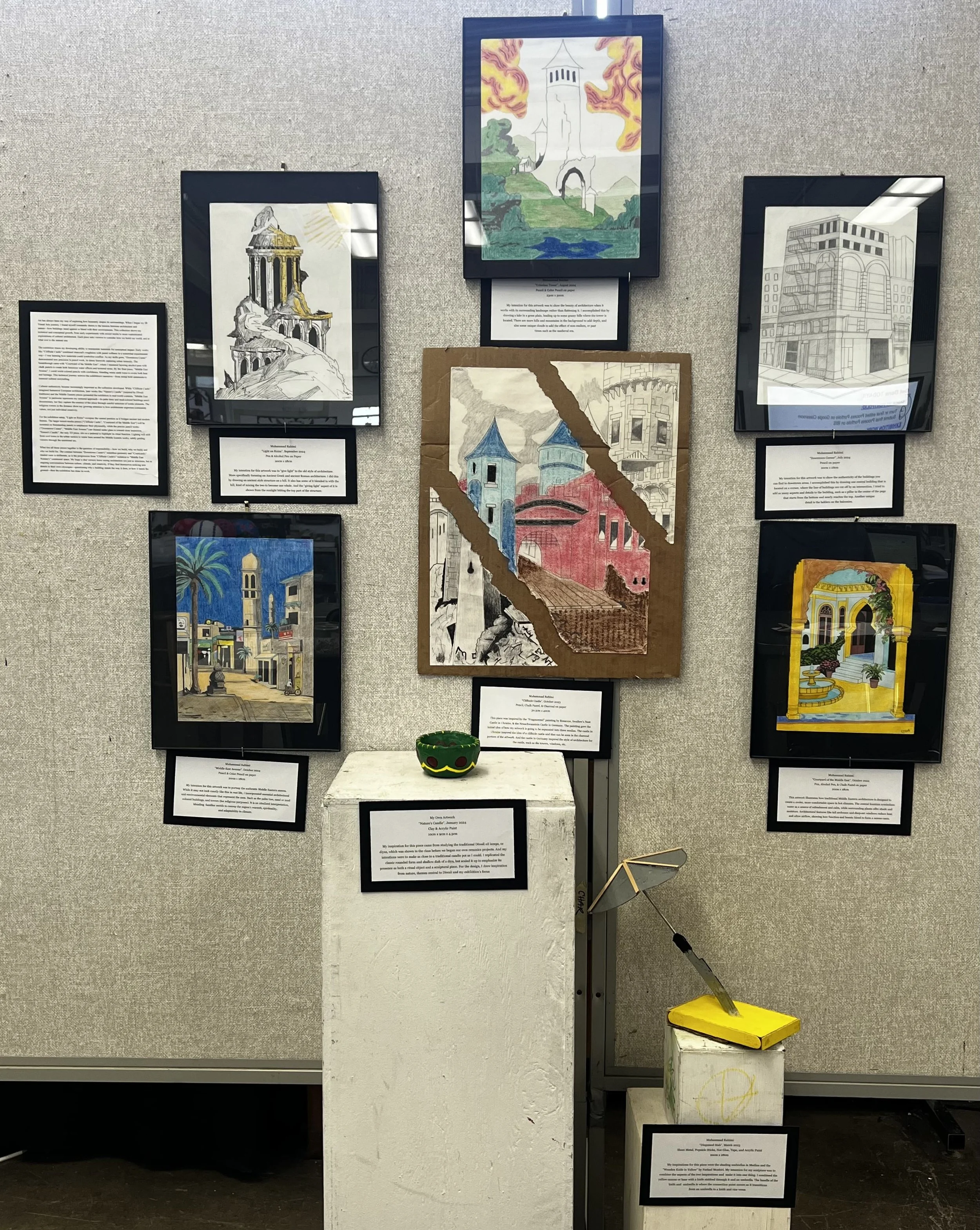
Art has always been my way of exploring how humanity shapes its surroundings. When I began my IB Visual Arts journey, I found myself constantly drawn to the tension between architecture and nature—how buildings stand against or blend with their environments. This collection shows my technical and conceptual growth, from early experiments with mixed media to more sophisticated explorations of cultural architecture. Each piece asks viewers to consider how we build our world, and at what cost to the natural one.
The exhibition traces my developing ability to manipulate materials for conceptual impact. Early works like “Cliffside Castle” combined charcoal's roughness with pastel softness in a somewhat experimental way—I was learning how materials could symbolize conflict. As my skills grew, “Downtown Center” demonstrated new precision in pencil work, its dense linework capturing urban intensity. The breakthrough came with “Courtyard of the Middle East”, where I mastered layering alcohol pens with chalk pastels to create both luminous water effects and textured stone. By the final piece, “Middle East Avenue”, I could wield colored pencils with confidence, blending warm earth tones to evoke both heat and heritage. This technical journey mirrors the exhibition's narrative—from initial bold statements to nuanced cultural storytelling.
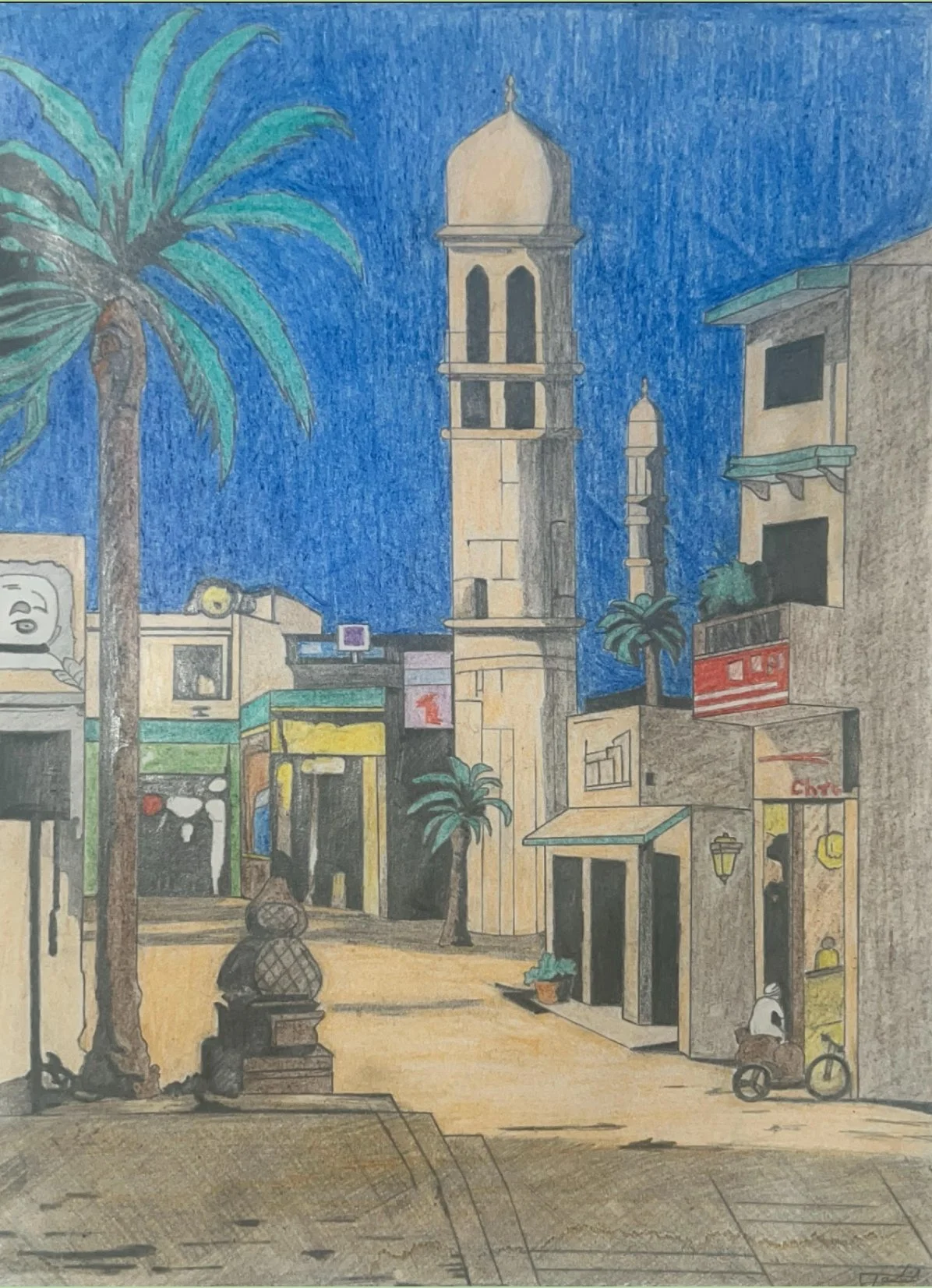
Cultural authenticity became increasingly important as the collection developed. While “Cliffside Castle” imagined fantastical European architecture, later works like “Nature's Candle” (inspired by Diwali traditions) and the Middle Eastern pieces grounded the exhibition in real-world contexts. “Middle East Avenue” in particular represents my matured approach—its palm trees and mud-colored buildings aren't documentary, but they capture the essence of the place through careful selection of iconic elements. The religious towers in the distance show my growing attention to how architecture expresses community values, not just individual creativity.
For the exhibition setup, “Light on Ruins” occupies the central position as it bridges ancient and modern themes. The larger mixed-media pieces (“Cliffside Castle”, “Courtyard of the Middle East”) will be mounted on freestanding panels to emphasize their physicality, while the precise pencil works (“Downtown Center”, “Middle East Avenue”) are framed under glass to reward close inspection. “Nature's Candle”, the only 3D piece, sits on a pedestal to highlight its ritual function. Lighting will shift from cool tones in the urban section to warm hues around the Middle Eastern works, subtly guiding viewers through the emotional arc.
What ties all these pieces together is the question of responsibility—how we build, why we build, and who we build for. The contrast between “Downtown Center’s” relentless geometry and “Courtyard's” shaded oasis is deliberate, as is the progression from “Cliffside Castle's” isolation to “Middle East Avenue's” communal space. My hope is that viewers leave seeing architecture not just as structures, but as ongoing conversations between culture, climate, and creativity. If they find themselves noticing new details in their own cityscapes—questioning why a building stands the way it does, or how it meets the ground—then the exhibition has done its work.
Muhammad’s Artwork
-
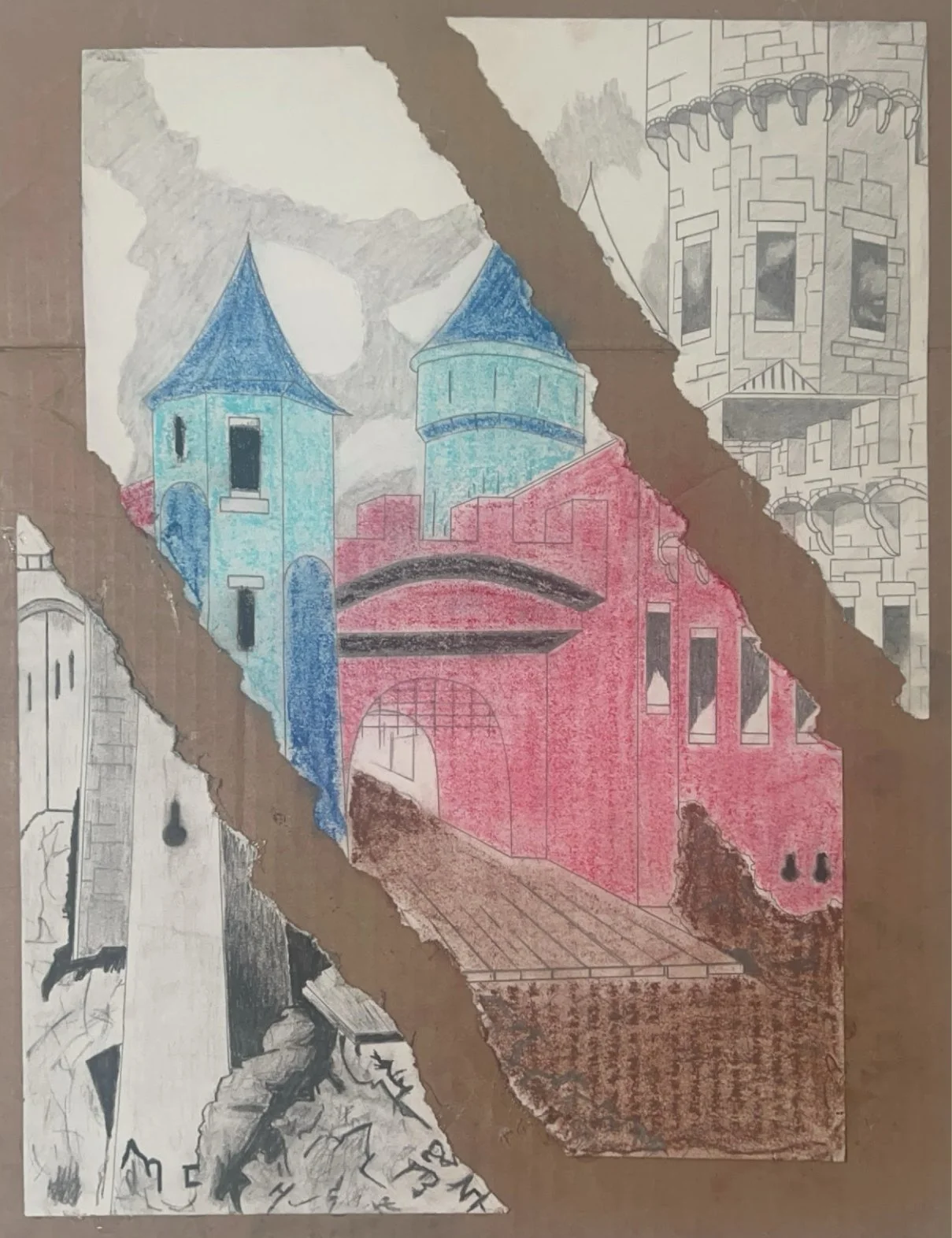
Cliffside Castle
Pencil, Chalk Pastel, & Charcoal on paper, 30.5 cm x 42 cm
This piece was inspired by the Fragmented painting by Rossouw, Swallow’s Nest Castle in Ukraine, & the Neuschwanstein Castle in Germany. The painting gave the initial idea of how my artwork is going to be separated into three medias. The castle in Ukraine inspired the idea of a cliffside castle and that can be seen in the charcoal portion of the artwork. And the castle in Germany inspired the style of architecture for the castle, such as the towers, windows, etc.
-
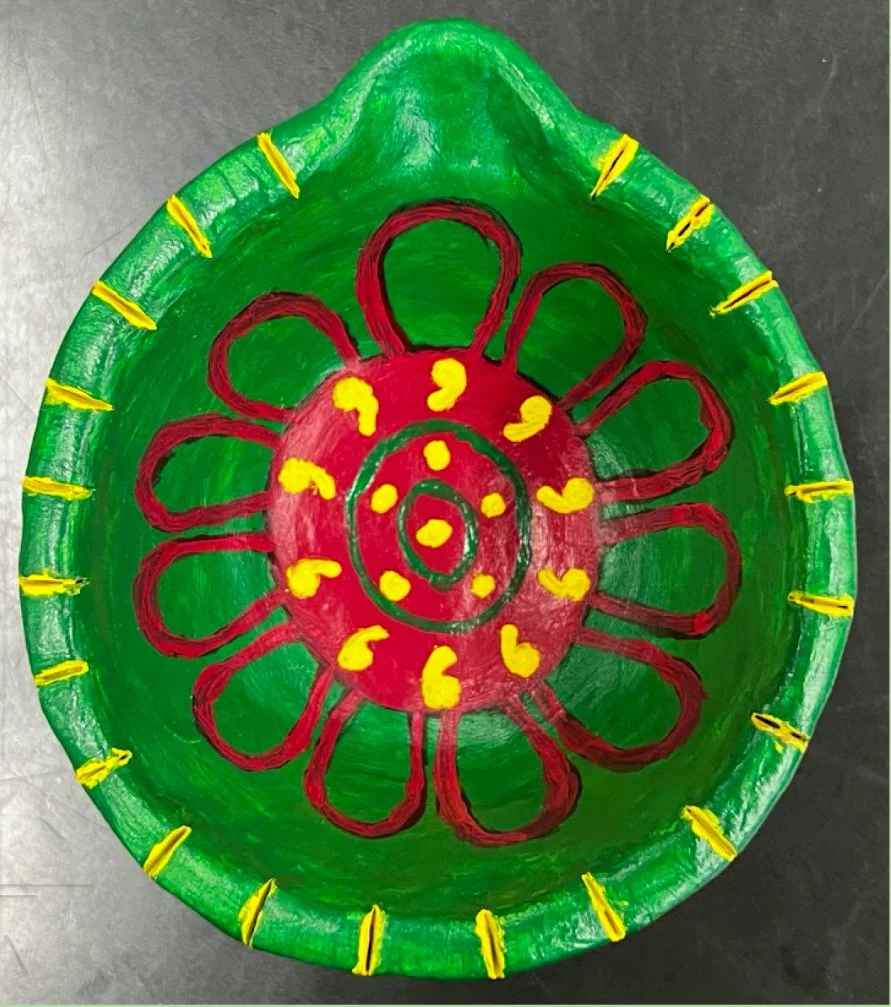
Nature's Candle
Clay & Acrylic Paint, 10 cm x 9 cm x 4.5 cm
My inspiration for this piece came from studying the traditional Diwali oil lamps, or diyas, which was shown to the class before we began our own ceramics projects. And my intentions were to make as close to a traditional candle pot as I could. I replicated the classic rounded form and shallow dish of a diya, but scaled it up to emphasize its presence as both a ritual object and a sculptural piece. For the design, I drew inspiration from nature, themes central to Diwali and my exhibition’s focus.
-
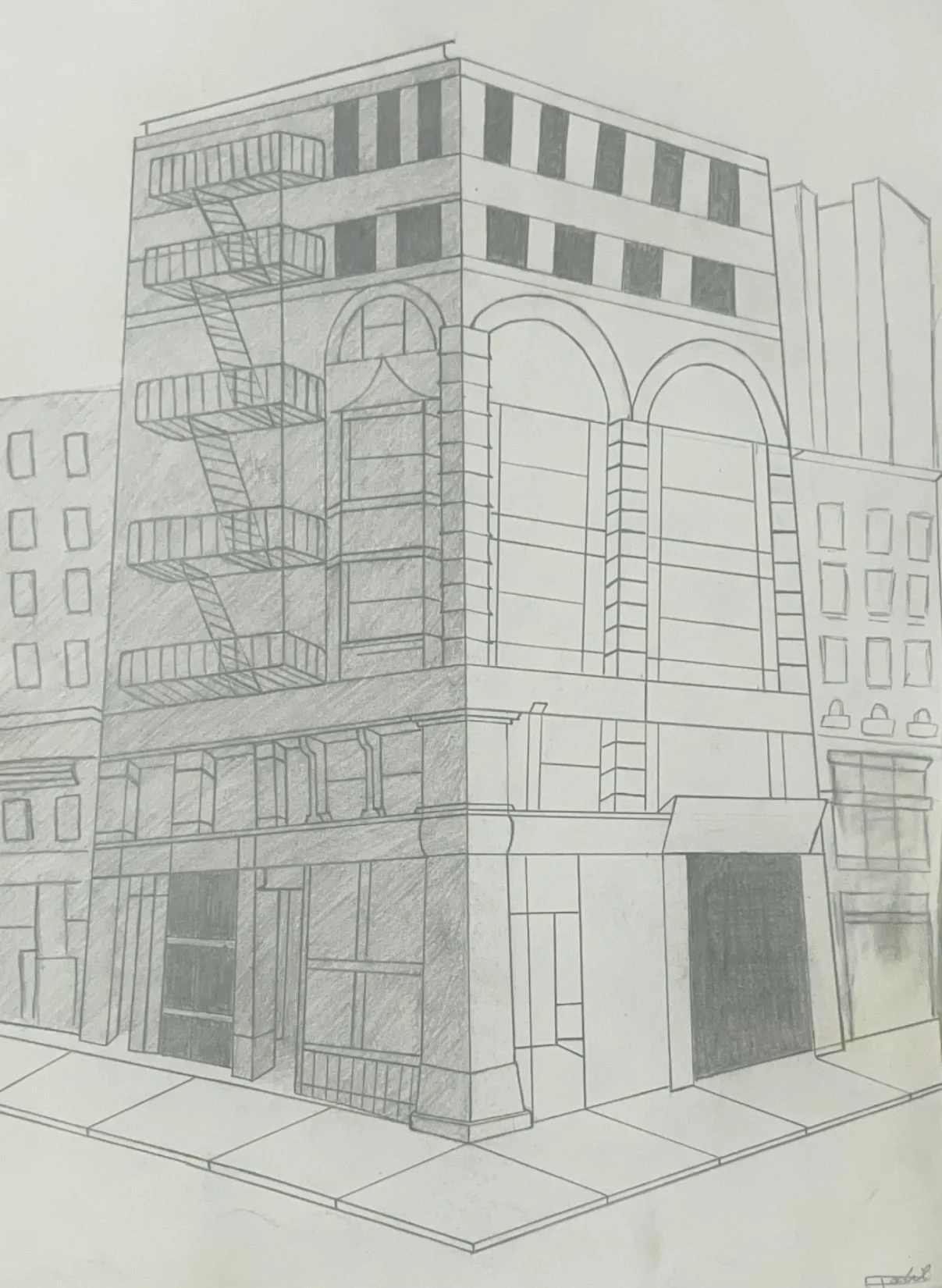
Downtown Corner
Pencil on paper, 20 cm x 28 cm
My intention for this artwork was to show the authenticity of the buildings you can find in downtown areas. I accomplished this by drawing one central building that is located on a corner, where the line of buildings are cut off by an intersection. I tried to add as many aspects and details to the building, such as a pillar in the center of the page that starts from the bottom and nearly reaches the top. Another unique detail is the ladders on the balconies.
-
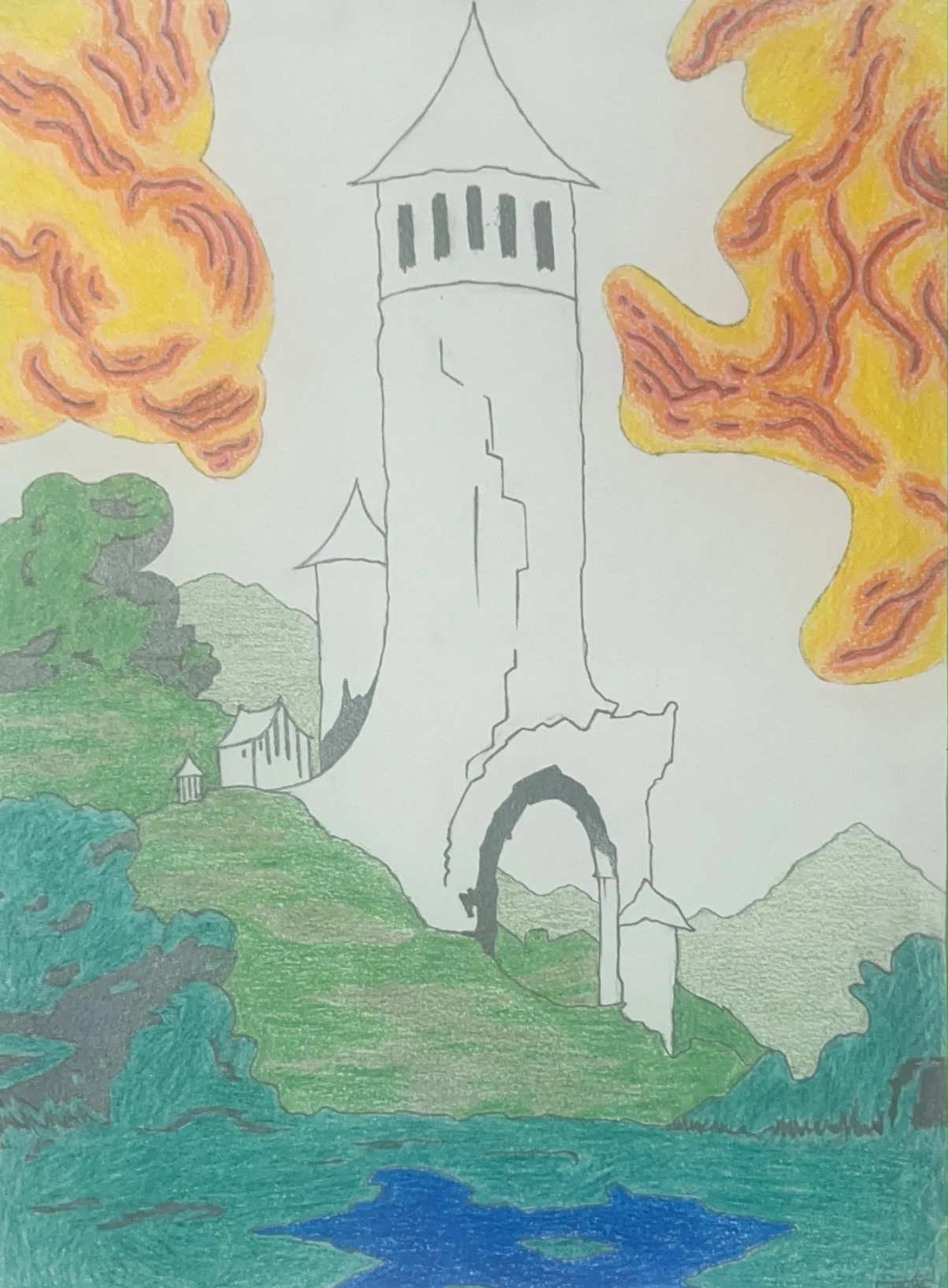
Colorless Tower
Pencil & Color Pencil on paper, 23 cm x 30 cm
My intention for this artwork was to show the beauty of architecture when it works with its surrounding landscape rather than flattening it. I accomplished this by drawing a lake in a grass plain, leading up to some grassy hills where the tower is located. There are more hills and mountains in the background to add depth, and also some unique clouds to add the effect of non-realism, or past times such as the medieval era.
-
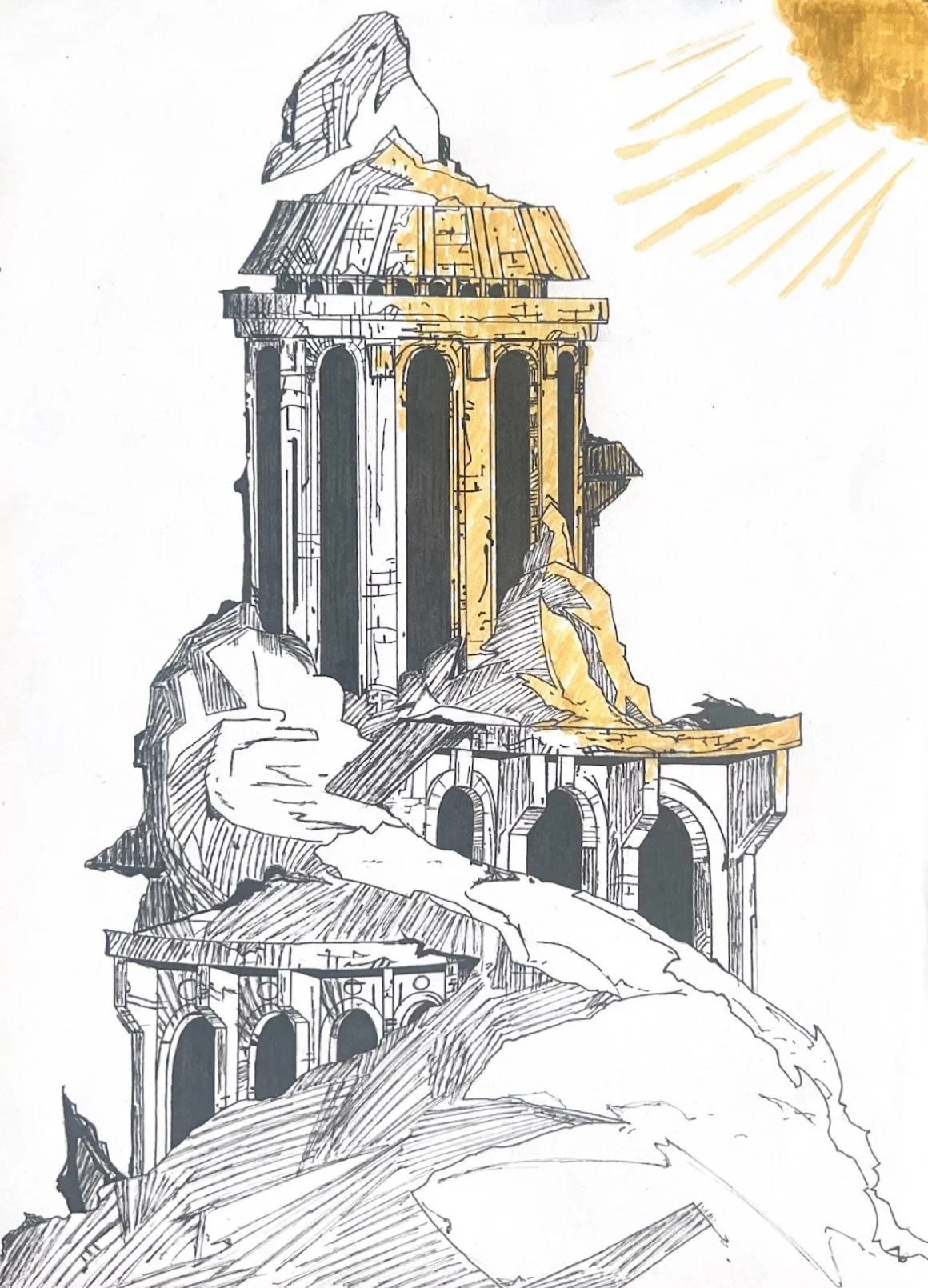
Light on Ruins
Pen & Alcohol Pen on Paper, 20 cm x 28 cm
My intention for this artwork was to “give light” to the old style of architecture. More specifically focusing on Ancient Greek and ancient Roman architecture. I did this by drawing an ancient style structure on a hill. It also has some of it blended in with the hill, kind of mixing the two to become one whole. And the “giving light” aspect of it is shown from the sunlight hitting the top part of the structure.
-
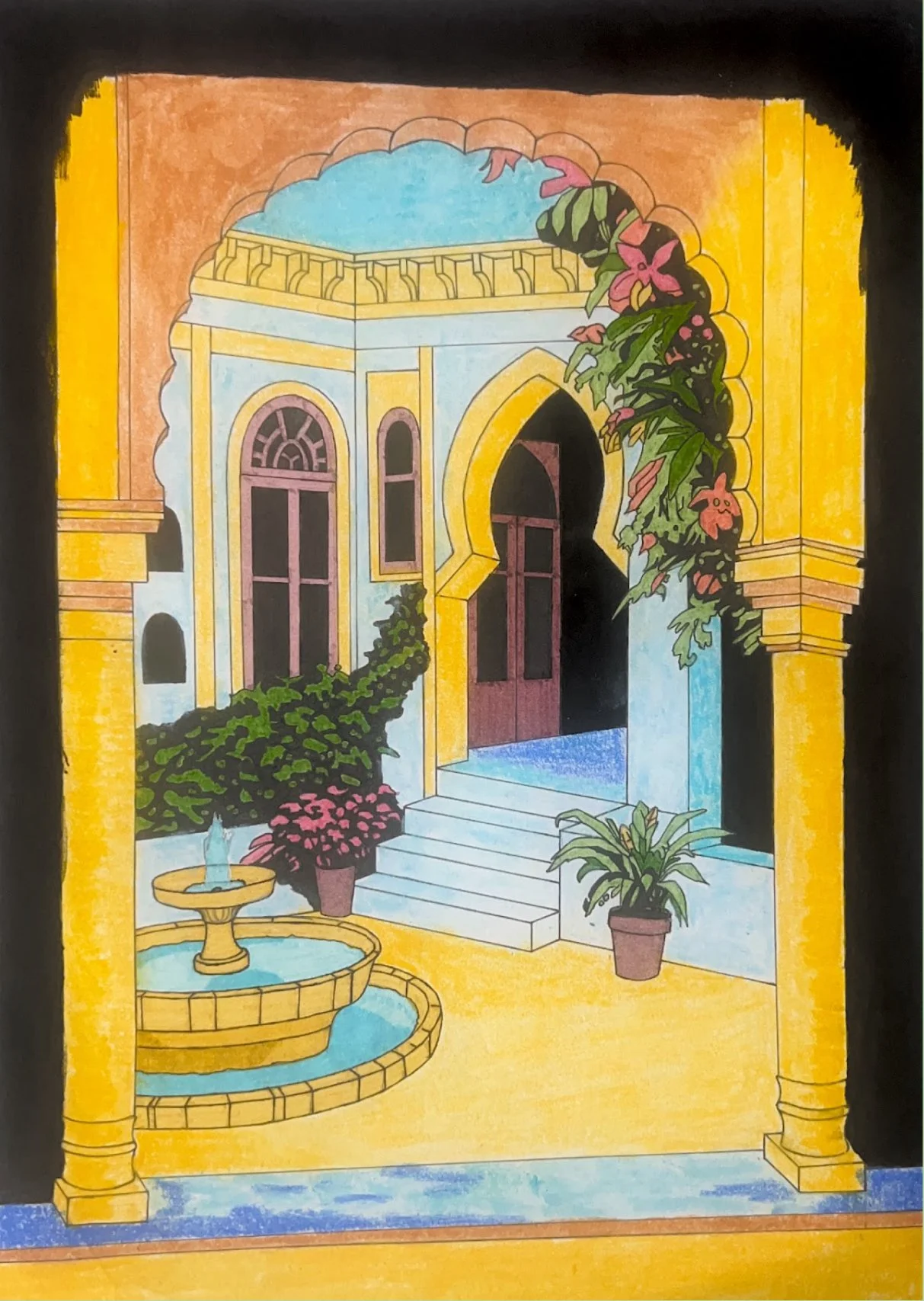
Courtyard of the Middle East
Pen, Alcohol Pen, & Chalk Pastel on paper, 20 cm x 28 cm
This artwork illustrates how traditional Middle Eastern architecture is designed to create a cooler, more comfortable space in hot climates. The central fountain symbolizes water as a source of refreshment and calm, while surrounding plants offer shade and moisture. Architectural features like tall archways and deep-set windows reduce heat and allow airflow, showing how function and beauty blend to form a serene oasis.
-
Middle East Avenue
Pencil & Color Pencil on paper, 20 cm x 28 cm
My intention for this artwork was to portray the authentic Middle Eastern streets. While it may not look exactly like this in real life, I incorporated essential architectural and environmental elements that represent the area. Such as the palm tree, sand or mud colored buildings, and towers (for religious purposes). It is an idealized interpretation, blending familiar motifs to convey the region’s warmth, spirituality, and adaptability to climate.
-
Disguised Stab
Sheet Metal, Popsicle Sticks, Hot Glue, Tape, and Acrylic Paint, 20 cm x 28 cm
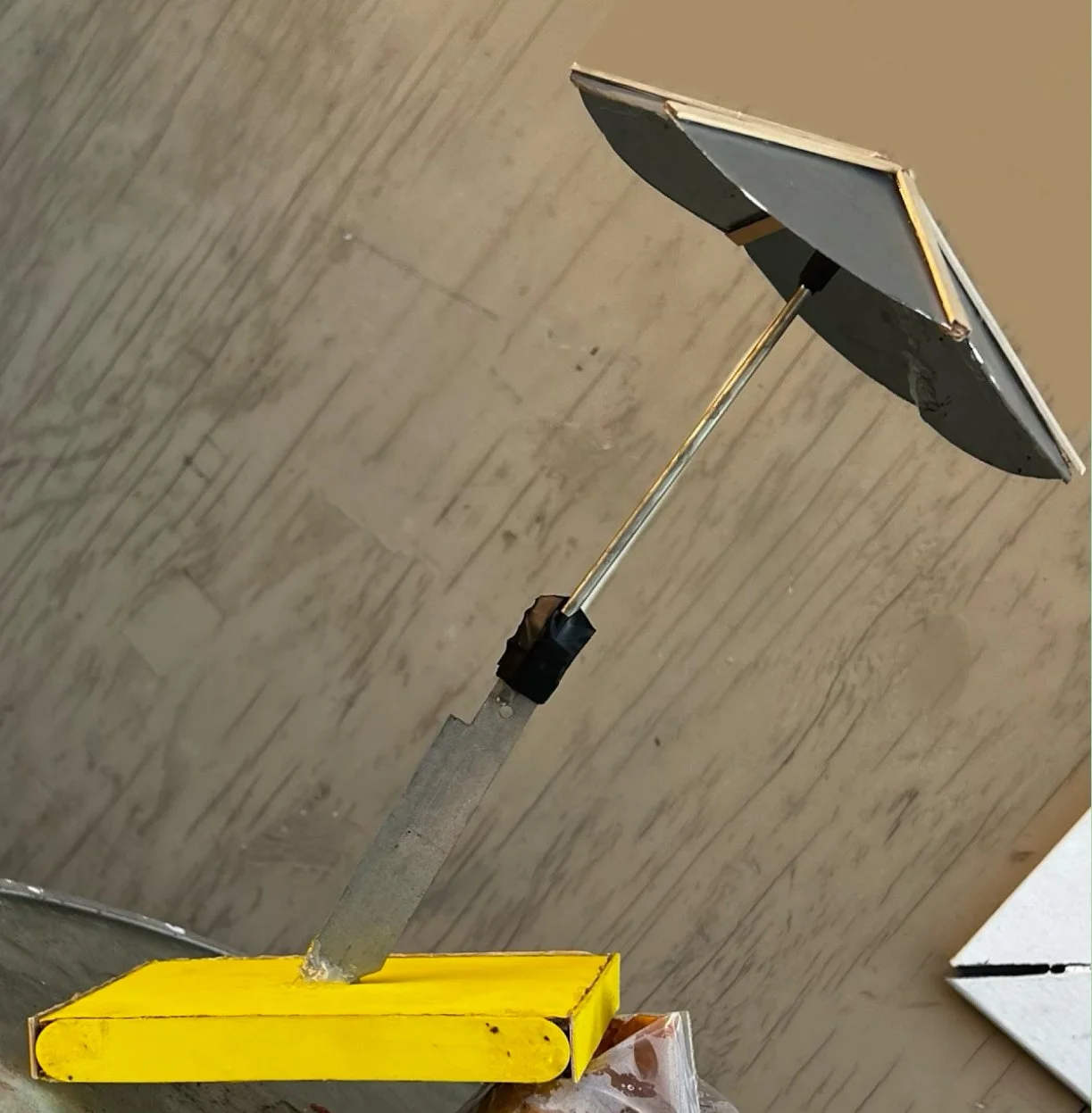
My inspirations for this piece were the shading umbrellas in Medina and the “Wooden Knife in Yellow” by Farhad Moshiri. My intention for my sculpture was to combine the aspects of the two inspirations and make it into one thing. I combined the yellow canvas or base with a knife stabbed through it and an umbrella. The handle of the knife and umbrella is where the connection point occurs as it transitions from an umbrella to a knife and vice versa.