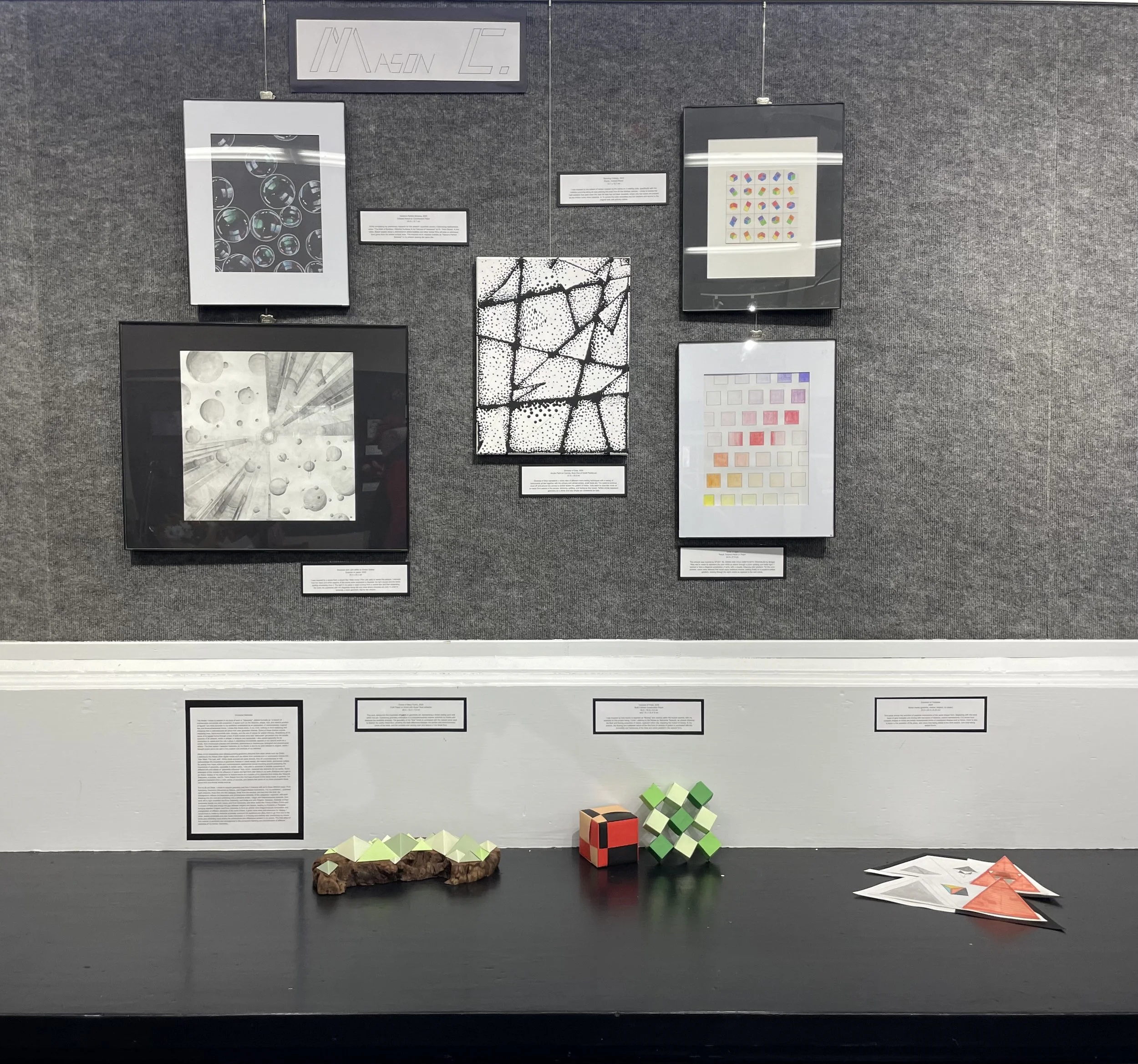
Mason Carter
“What is your favorite artwork?”
Curatorial Rationale
The theme I chose to explore in my body of work is “Geometry”, defined formally as “a branch of mathematics concerned with properties of space such as the distance, shape, size, and relative position of figures” but more accurate to my exhibition understood as an exploration of mathematically inspired two and three-dimensional forms. I chose this theme since, in my mind, nothing is more satisfying and intriguing than a well-executed art piece that uses geometric themes. Some of these themes include repeating lines, black-and-white color choices, and the use of values for added intricacy. Simplifying art to some of its basest forms through a lack of both human error and “real-world” grit leaves only the simple essence of an artwork, which is simpler to analyze and appreciate. I also picked geometry for its connection to nature and the role it plays in describing innumerable aspects of our natural world as a whole, from microscopic physics and chemistry phenomena to macroscopic biological and physiological effects. The final reason I selected Geometry as my theme is due to my prior interest in origami, which I thought would serve me well in the creation and analysis of my artworks.
Many of my inspirations were already-existing geometric artworks from other artists such as Chōtō; Listening to the Waves other digital media such as videos from youtube.com or mainstream movies like “Star Wars: The Last Jedi”. While these sources are quite diverse, they all (unconsciously or not) acknowledge the importance of geometric themes in visual design, the natural world, and human culture. By seeing how these artists and mathematicians approached issues revolving around presenting the importance of geometry, especially in artistic ways, I was able to assemble a variable cacophony of different bits and pieces of “geometric influence” from which I selected key elements for my works. Some examples of this include the influence of space and light from Star Wars in my work Shadows and Light in an Empty Galaxy or my inspiration to feature nature as a subject of my artworks from artists like Takayuki Sakiyama, a sculptor, and Dr. Trefor Bazett from the YouTube channel of the same name. In general, I’ve gathered inspiration from a wide variety of sources, and believe that some of my most successful ideas came from non-formal artists such as.
For my IB Art Show, I chose to explore geometry and how it interacts with art in three different ways: Pure Geometry, Geometry Influenced by Nature, and Origami-Based Geometries. For my exhibition, I gathered eight artworks: three from the first category, three from the second, and two from the third. My arrangement reflects the separation and simultaneous similarity of the categories I explored, with each blending into the next and combining into a cohesive whole. I begin with Nature-inspired artworks, then work left to right transition into Pure Geometry, and finally end with Origami. However, Diversity of Dots somewhat blends into both nature and Pure Geometry, and other works like Forest of Many Forms and Contrast of Folds also bridge the gap between origami and Nature, leading to Evolution of Triangles bringing together Origami and Pure Geometry to form an almost Venn Diagram-esque comparison and juxtaposition of different elements of the same theme. If given more room and resources for display, I would hope to make my artworks physically surround the audience and allow them to go from one to the other, seeing similarities and new ideas introduced, in a looping and endless way (reinforcing my theme while also exhibiting more clearly the connections and differences present in my piece). The final effect of this method of exhibition and arrangement is the concurrent blending and diversification of different elements of my theme: Geometry.
Mason’s Art Work
-
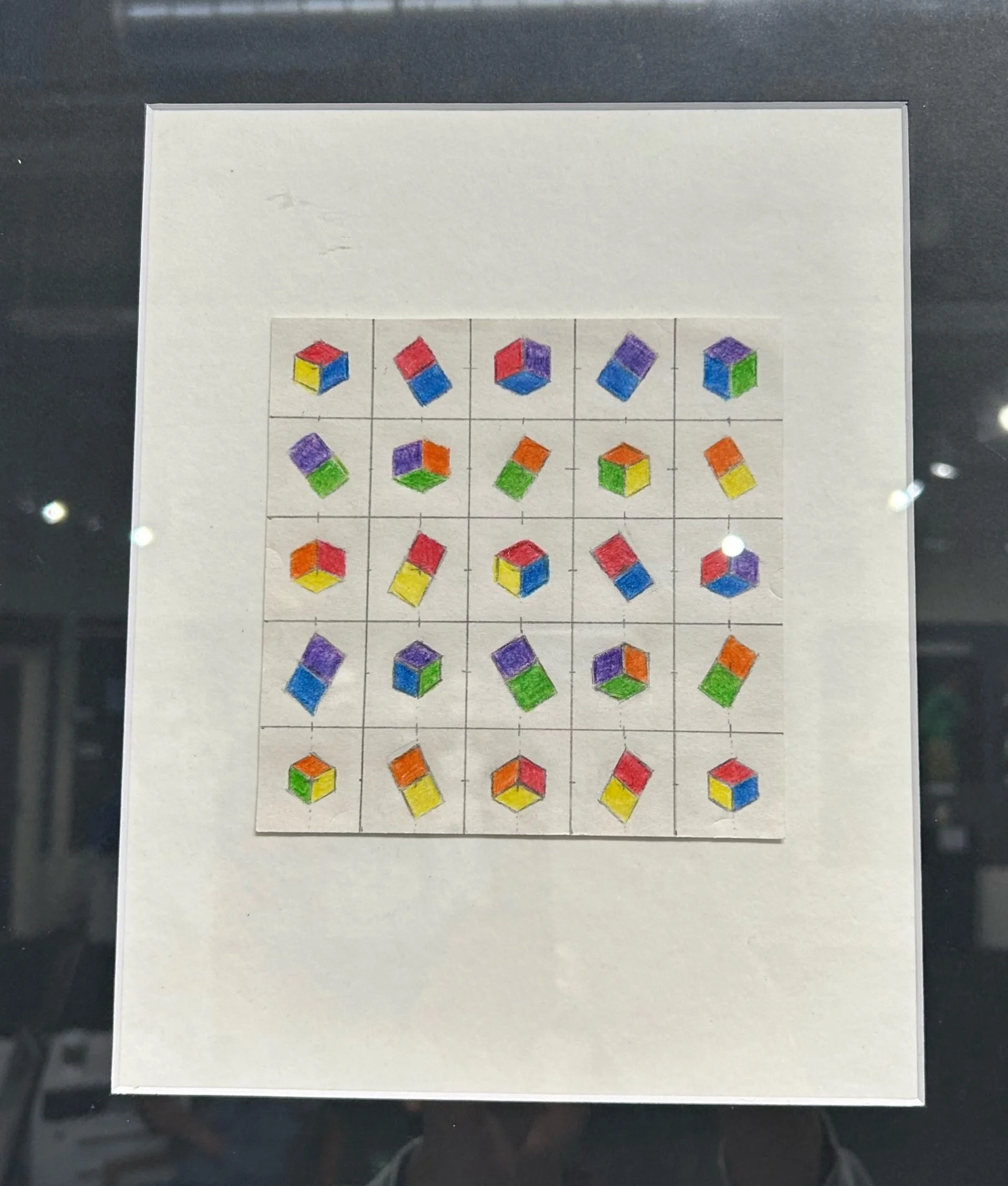
Spinning Cube(s)
Pencil, Colored Pencil
12.7 x 12.7 cm
I was inspired by the pattern of motion created by the colors on a rotating cube, specifically with the rotation occurring along an axis piercing the cube from its two farthest vertices. I chose to include the half-rotations that exist when the next full face has not been revealed, where only two colors are present as the motion looks more cohesive. In 16 panels the cube completes two full rotations and returns to the original side with primary colors.
-
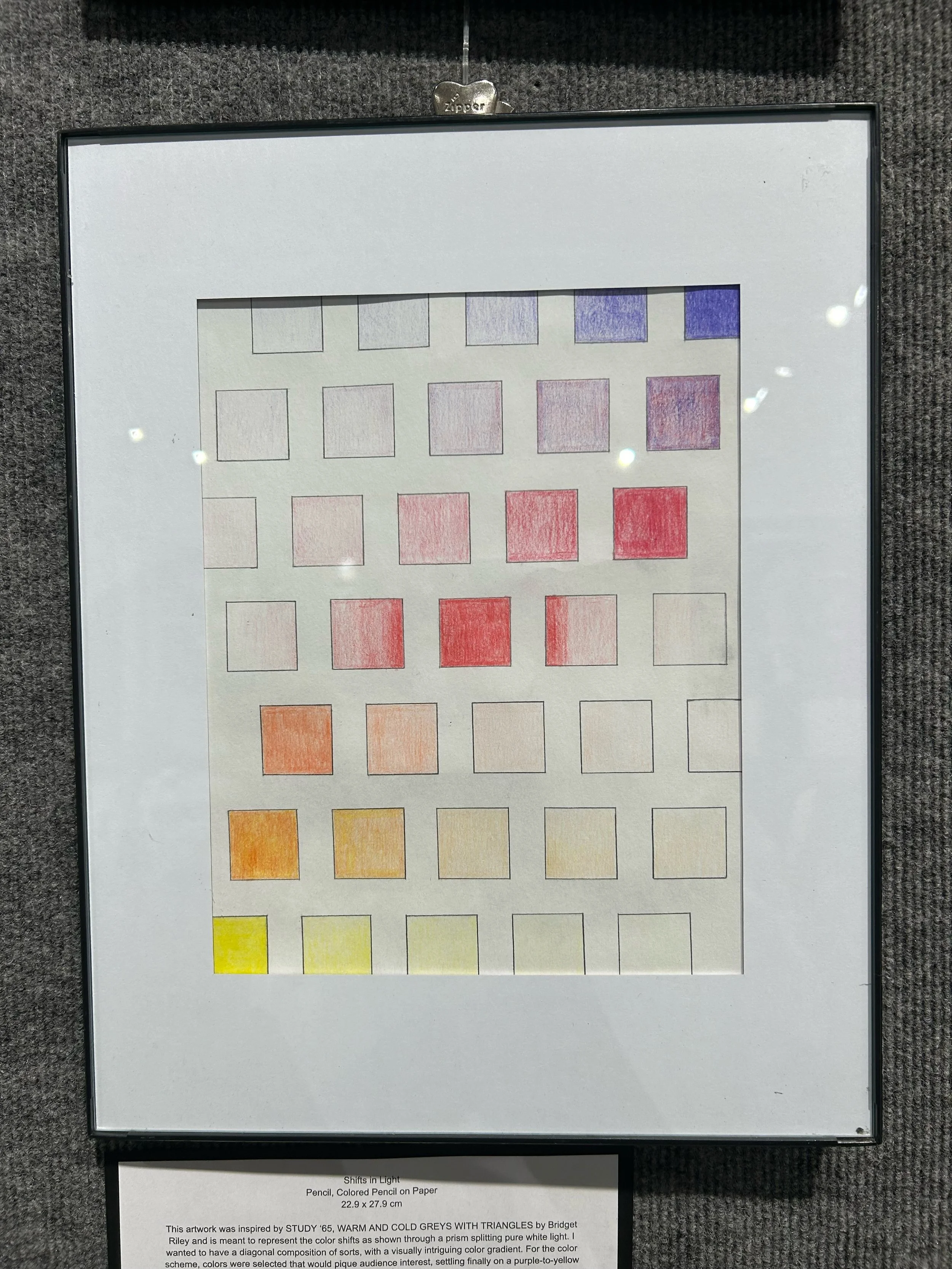
Shifts in Light
Pencil, Colored Pencil on Paper
22.9 x 27.9 cm
This artwork was inspired by STUDY ‘65, WARM AND COLD GREYS WITH TRIANGLES by Bridget Riley and is meant to represent the color shifts as shown through a prism splitting pure white light. I wanted to have a diagonal composition of sorts, with a visually intriguing color gradient. For the color scheme, colors were selected that would pique audience interest, settling finally on a purple-to-yellow gradient, rotating through the warm colors as opposed to the cool colors.
-
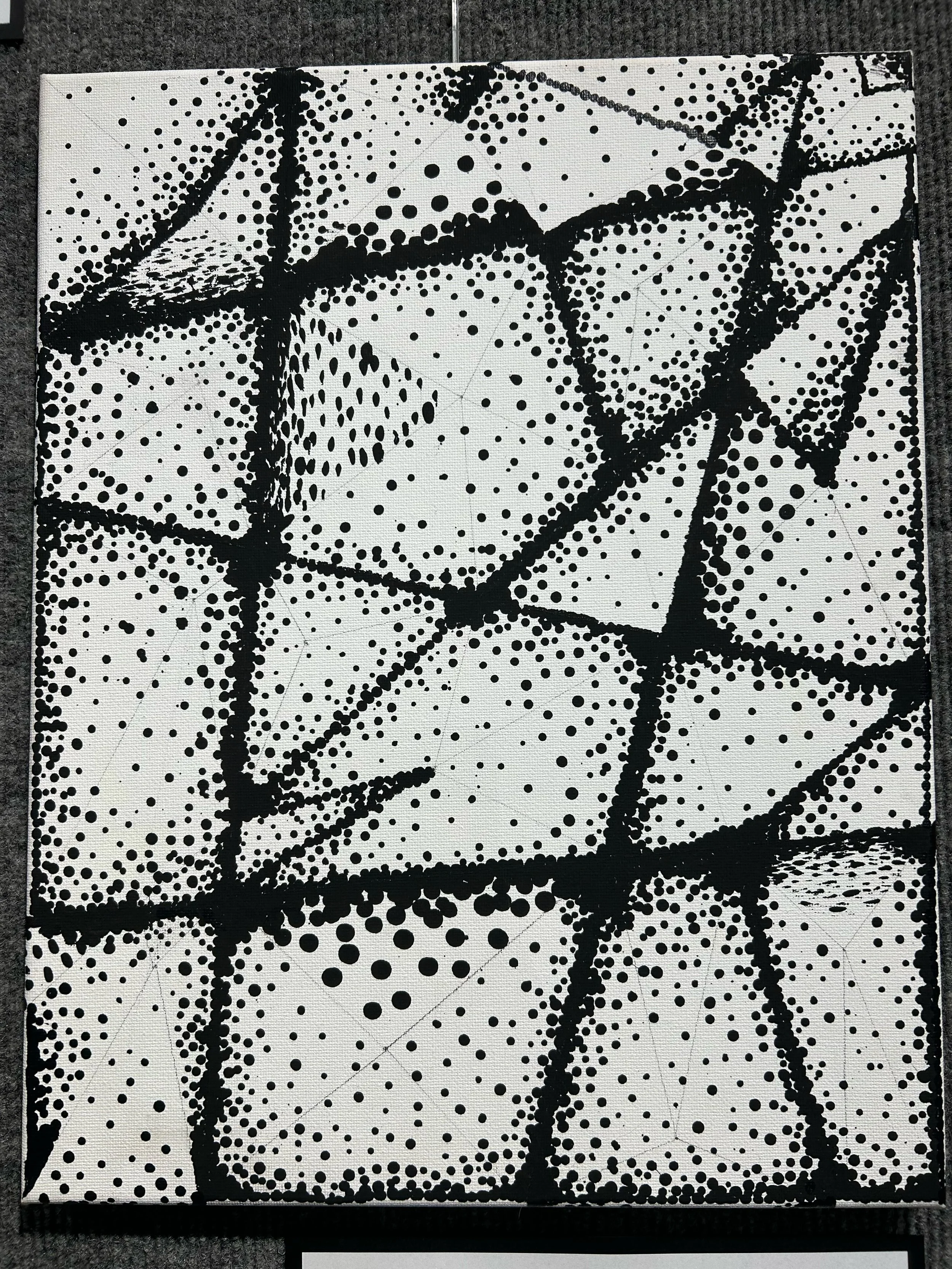
Diversity of Dots, 2024
Acrylic Paint on Canvas, Back End of Small Paintbrush
27.9 x 35.6 cm
Diversity of Dots represents a whole slew of different mark-making techniques with a variety of instruments all tied together with the primary and utmost simple, small black dot. The patterns continue even off and around the canvas to further extend the pattern of marks. Dots seem to ooze like crude oil on water from seams in the canvas: shrinking, splitting, and fading as they travel. Perfect circles represent geometry as a whole and how simple can sometimes be best.
-
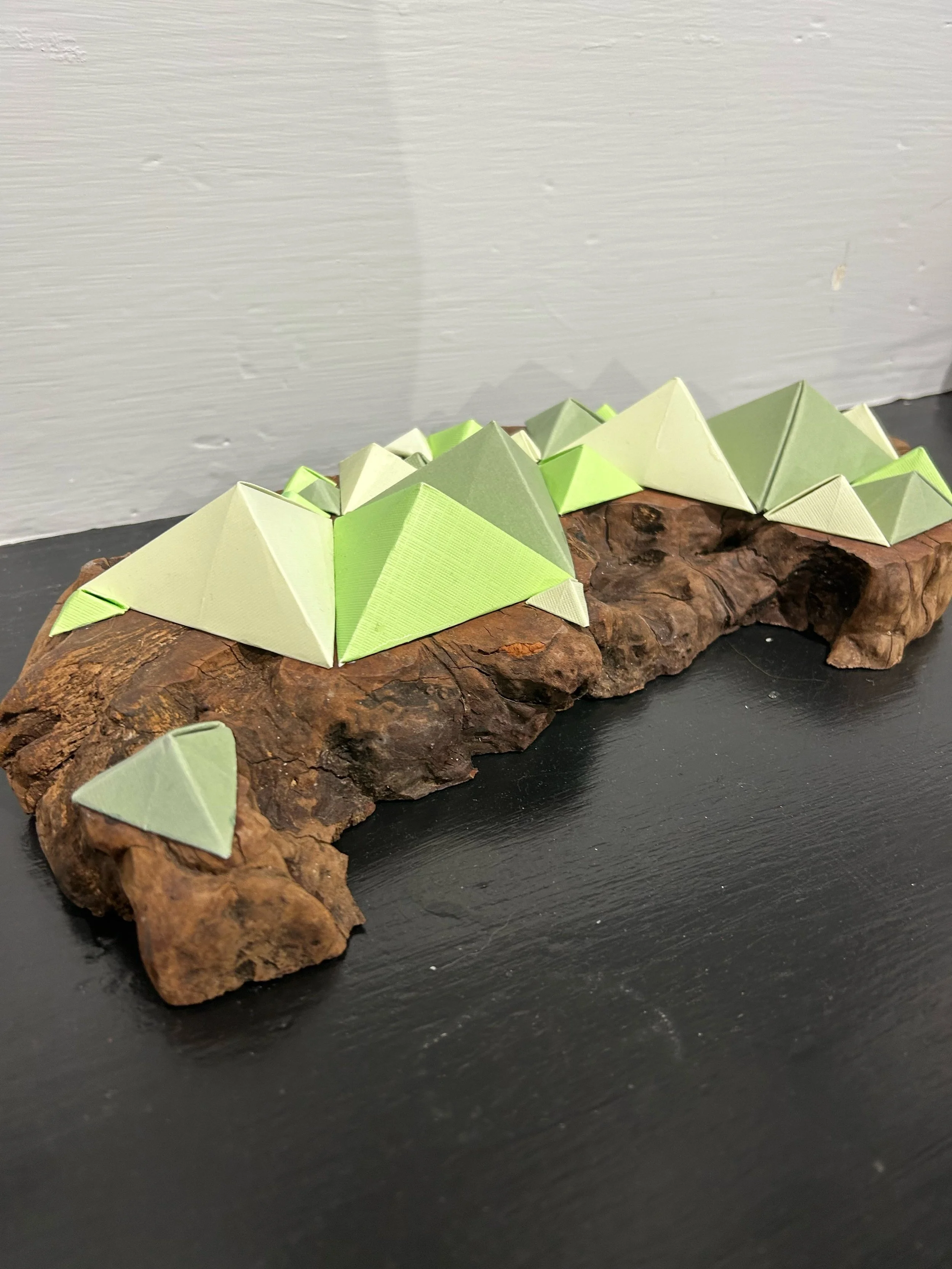
Forest of Many Forms, 2024
Craft Paper on Wood with Super Glue adhesive
29.5 x 13.2 x 7.6 cm
This work delves into the inspiration of nature in geometric art, representing a forest resting upon and within the soil. Combining geometry and nature in a compare-contrast manner enriches my theme and deepens the available analysis. The geometry of the "tree" forms is contrasted with the natural wood used to fashion the earthy forest floor, showing the stark difference between the perfect and monochromatic forms of the trees, and the complex and varying color and texture of the forest floor.
-
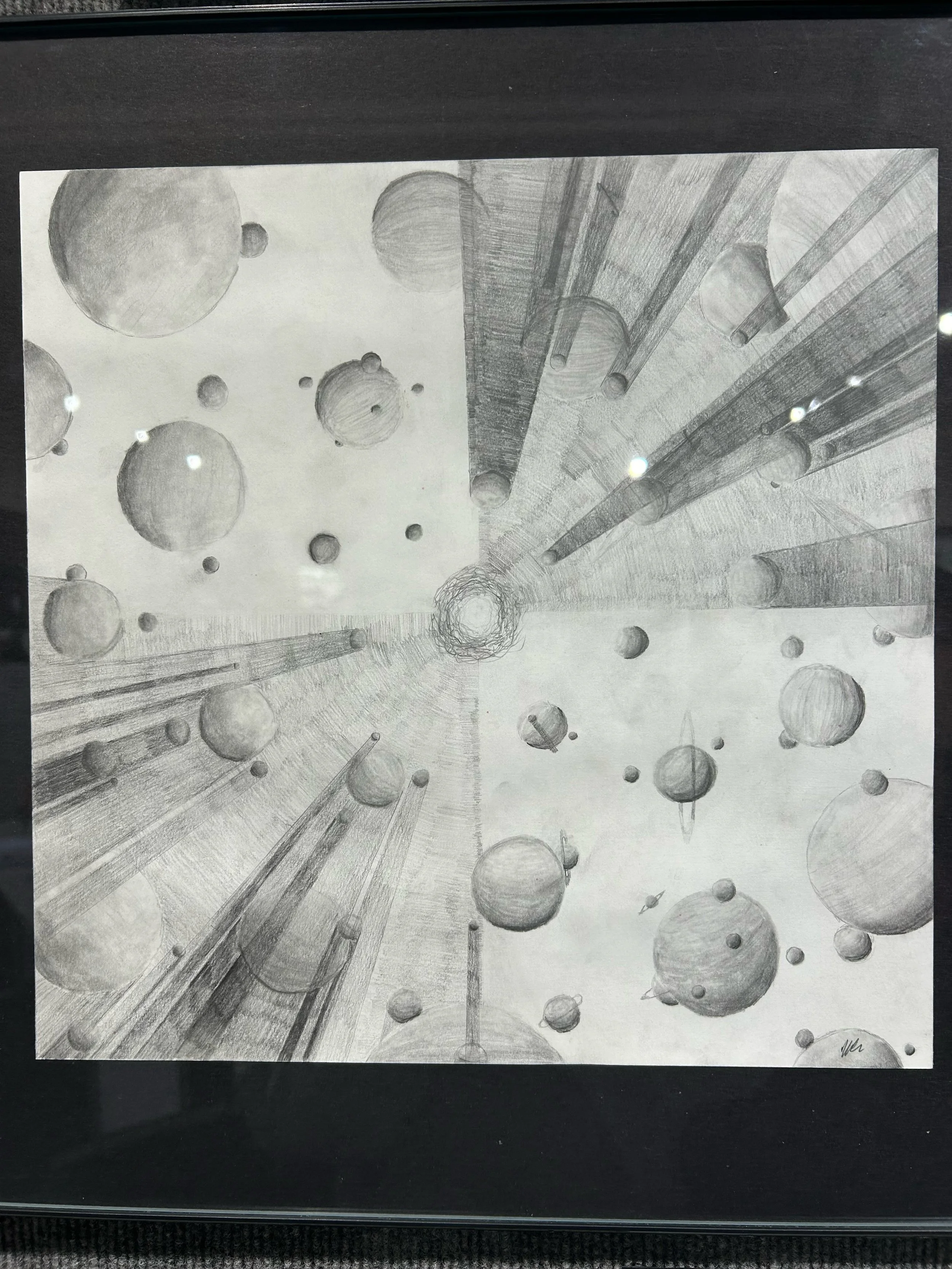
Shadows and Light within an Empty Galaxy
Graphite on paper, 2023
20.3 x 20.3 cm
I was inspired by a scene from a recent Star Wars movie (The Last Jedi) to create this artwork. I admired how the black and white aspects of the scene were contrasted to illustrate the light source and the harsh lighting emanating from it. The light in my piece is seen coming from a central star and then separating the work into quadrants with the diagonals being the only ones where shadows are cast, in order to emanate a more geometric feel for the artwork.
-
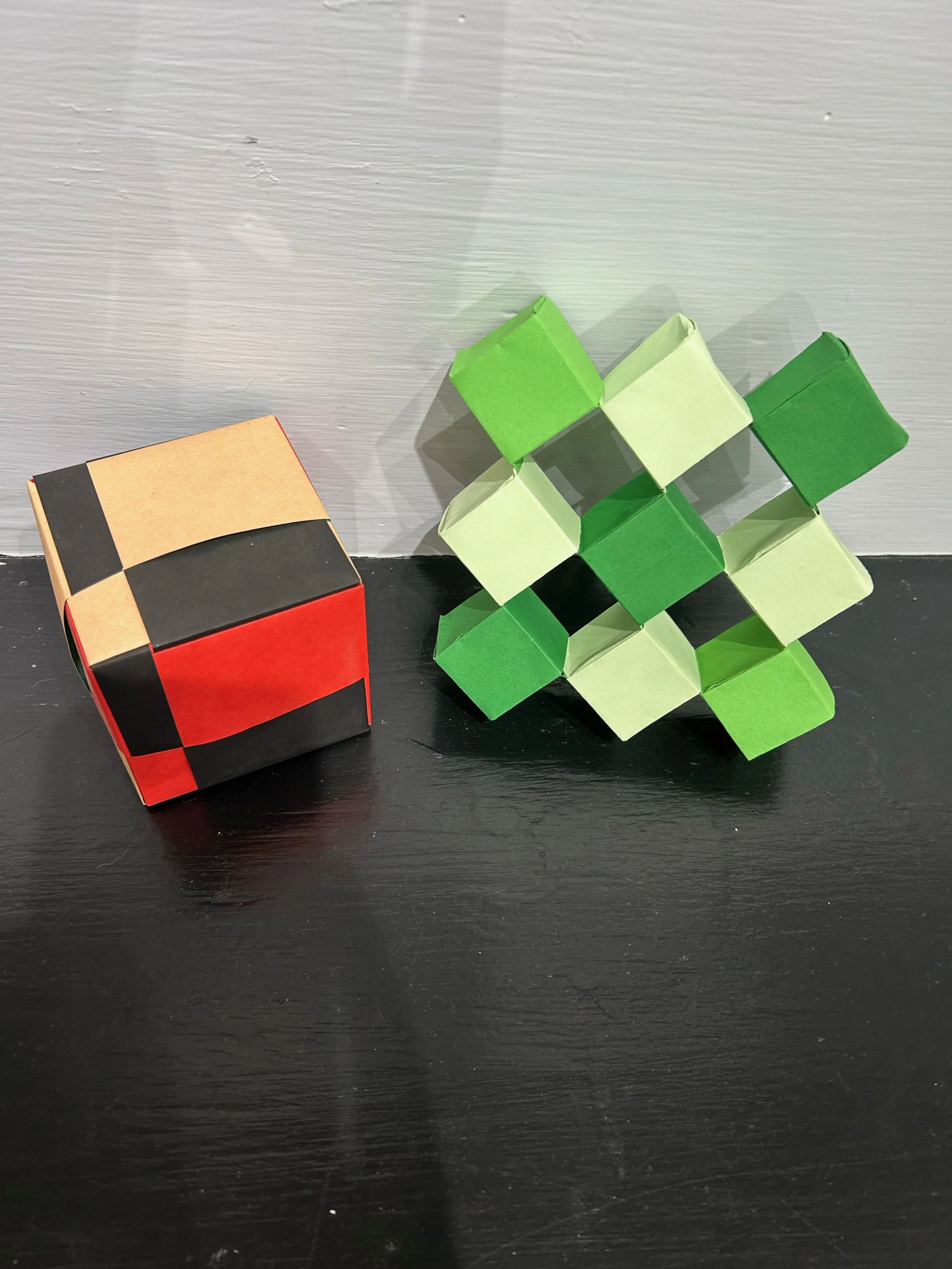
Contrast of Folds, 2024
Multi Colored Construction Paper
16.8 x 16.8 x 2.9 cm
and 7.6 x 7.6 x7.6 cm
I was inspired by how nature is depicted as “flowing” and viscous within the human psyche, with my example for this project being: Chōtō: Listening to the Waves by Sakiyama Takayuki, an artwork showing the fluid and flowing properties of nature, captured within clay depicting the motion of waves. In my artwork, the flowing and malleable nature of the first form (in shades of green) is contrasted with the immobility and harshness of the lines and colors present in the second form.
-
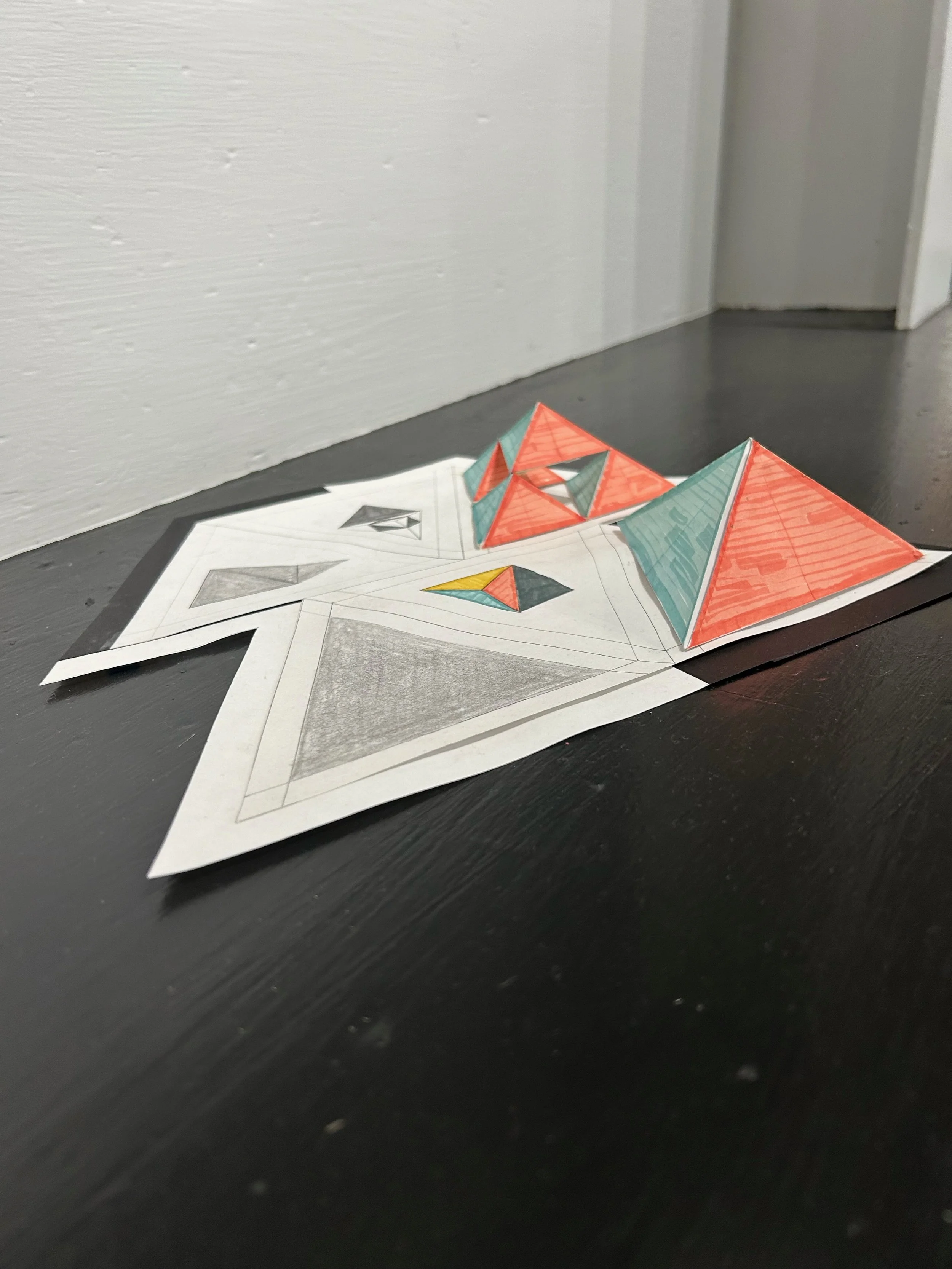
Evolution of Triangles
2023
Mixed media (graphite, marker, origami, on paper)
23.5 x 24.5 x 5.25 cm
This piece shows the evolution of possible interactions of the same shape/ form. Beginning with the most basic of grey triangles and ending with two layers of stacked, colorful tetrahedrons, it is shown how complex shapes or forms are simply compounded forms of constituent shapes and/ or forms. Color is also a factor in the evolution of the piece, with value only being added in the third section, and color being added fourth.
-
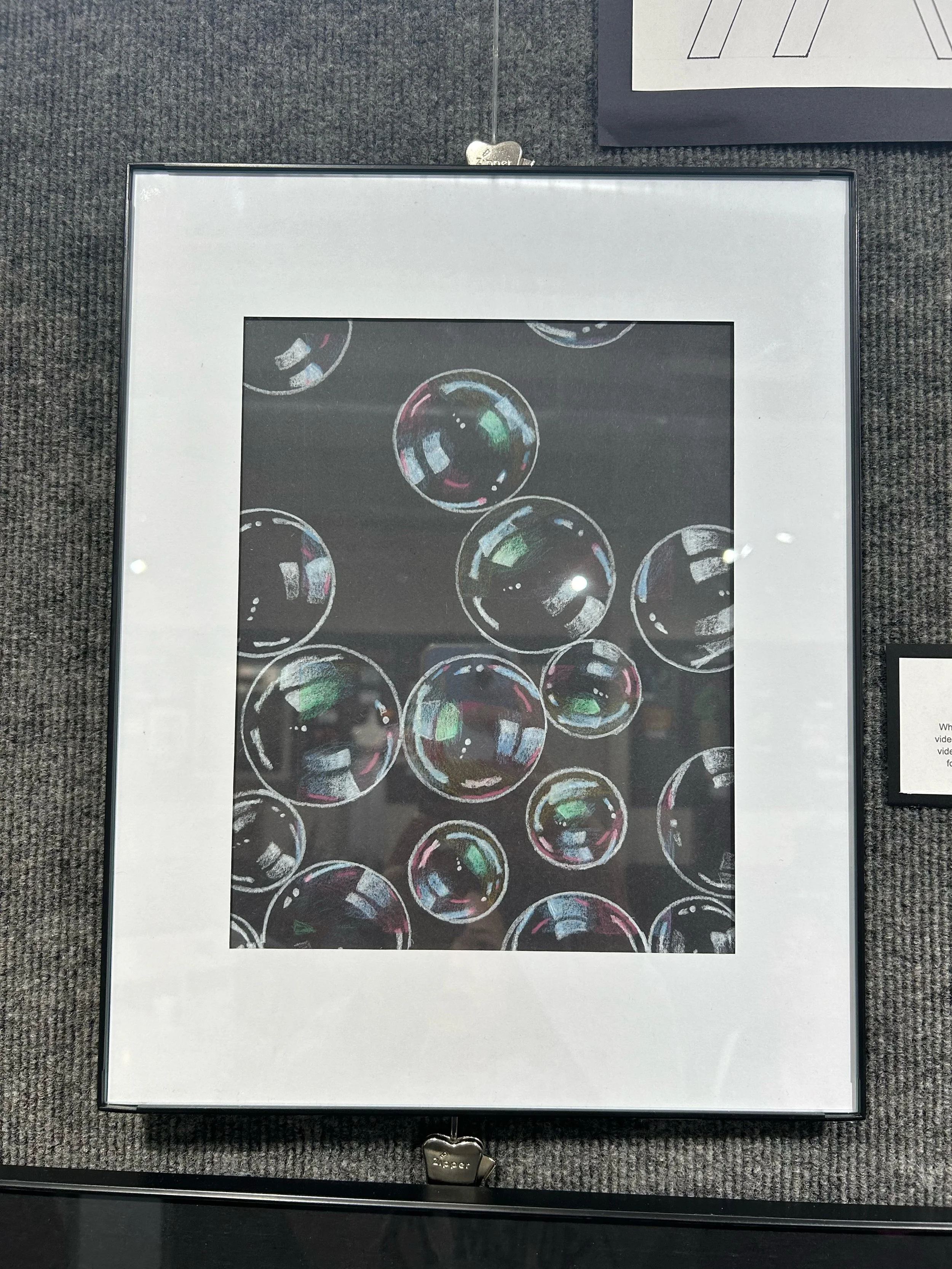
Nature’s Perfect Spheres, 2023
Colored Pencil on Construction Paper
20.3 x 12.7 cm
While completing my preliminary research for this artwork I stumbled across a fascinating mathematics video: "The Math of Bubbles // Minimal Surfaces & the Calculus of Variations" by Dr. Trefor Bazett. In this video, Bazett speaks about a phenomenon where bubbles and other similar films will take on whichever form gives them the lowest surface area. This inspired me to visualize bubbles as "Nature's Perfect Spheres" in my artwork bearing the same title.